
What High-Quality Data Is · the 4+5 Dimensions
Chapter 4 · the 4 dimensions are the entry ticket; the 9 dimensions are AI-era maturity
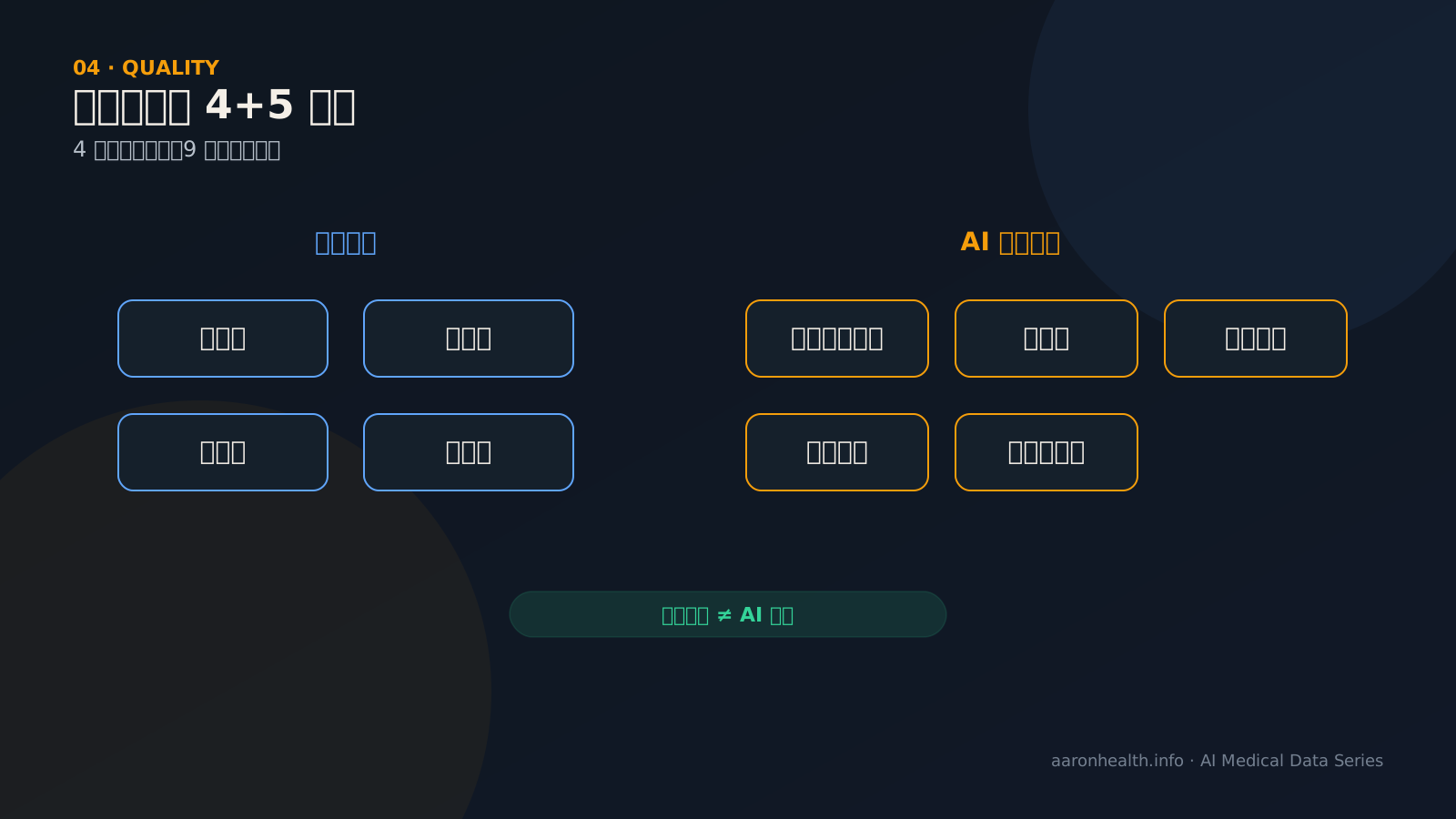
This chapter is the “professional muscle” of the whole talk. It has to be driven home.
The traditional base: the 4 dimensions of the national EMR grading standard
The National Health Commission’s Application Maturity Grading Standard for EMR Systems defines four data-quality dimensions:
| Dimension | Definition | Counter-example |
|---|---|---|
| Completeness | Every field that should be there is there; no key item missing | A note missing the chief complaint or the discharge diagnosis |
| Consistency | The same information is logically consistent across systems and tables | Patient sex is male in HIS, female in LIS |
| Integration | Data across systems and across business lines can be linked into a complete view | Lab orders can’t be linked to physician orders |
| Timeliness | Data is entered on schedule, not backfilled after the fact | Notes backfilled in bulk after the fact |
⚠️ A tell of expertise: a lot of people mis-state “integration” as “correlation.” The original term is Integration — it stresses the inner logical closure that comes after cross-domain integration. Correlation is a statistical notion; it’s not the same thing. A one-word slip like this exposes how deep your expertise really goes.
The turn: the traditional 4 dimensions aren’t enough
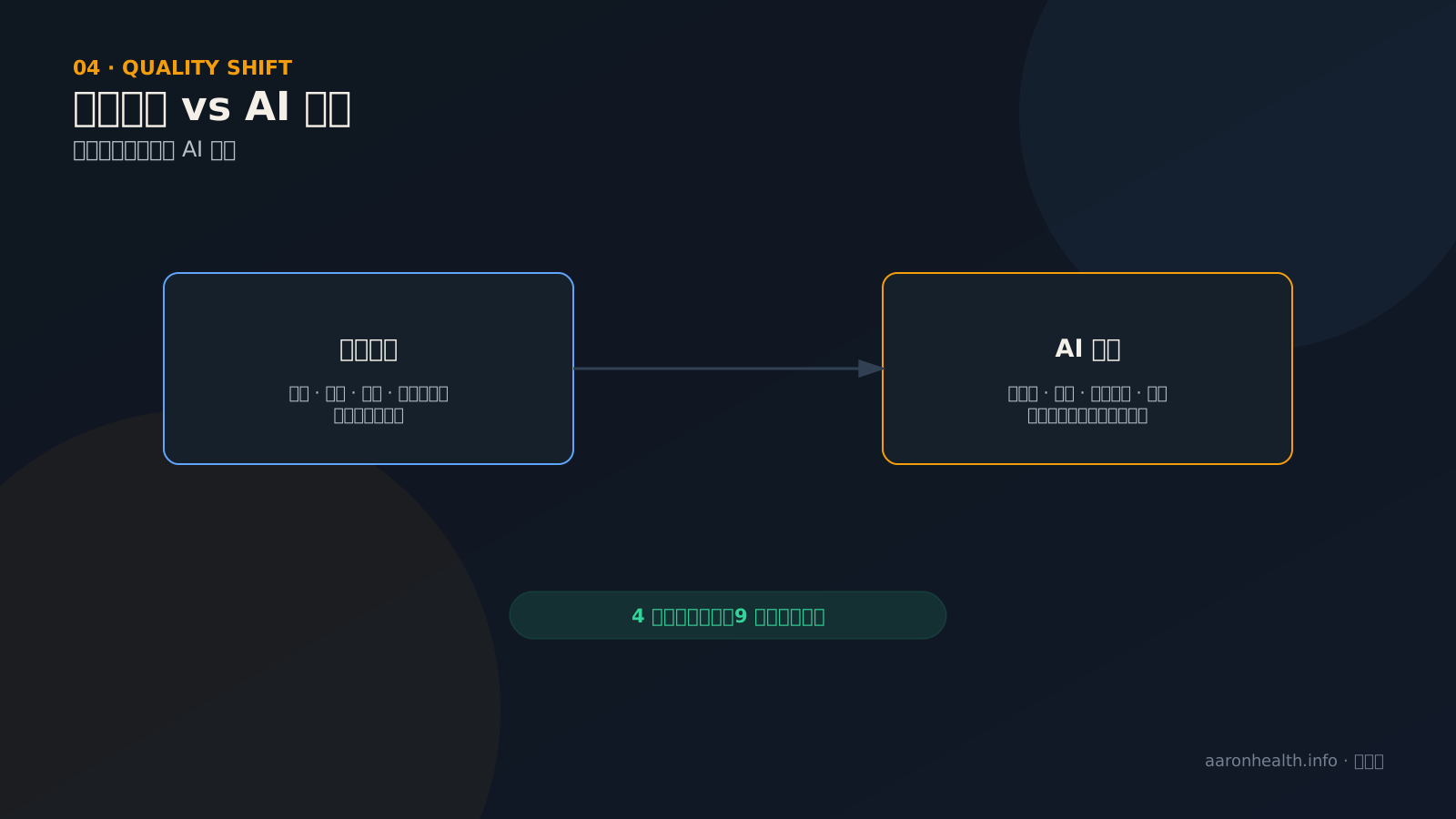
The traditional 4 dimensions solve “the business can run,” not “AI can learn.”
| Dimension | Traditional (operations view) | AI era (training / inference view) |
|---|---|---|
| Goal | Data is usable for care and management | Data lets a model learn, reason, and decide |
| Standard | Compliant, closed-loop, auditable | Compliant + diverse + knowledge-dense + aligned to human expert judgment |
| Fatal flaw | Missing, wrong | Bias, spurious correlation, shallow knowledge |
The traditional 4 dimensions are the entry ticket. The age of AI redefines what “high quality” means.
An international reference: how to build a clinical-note quality dataset
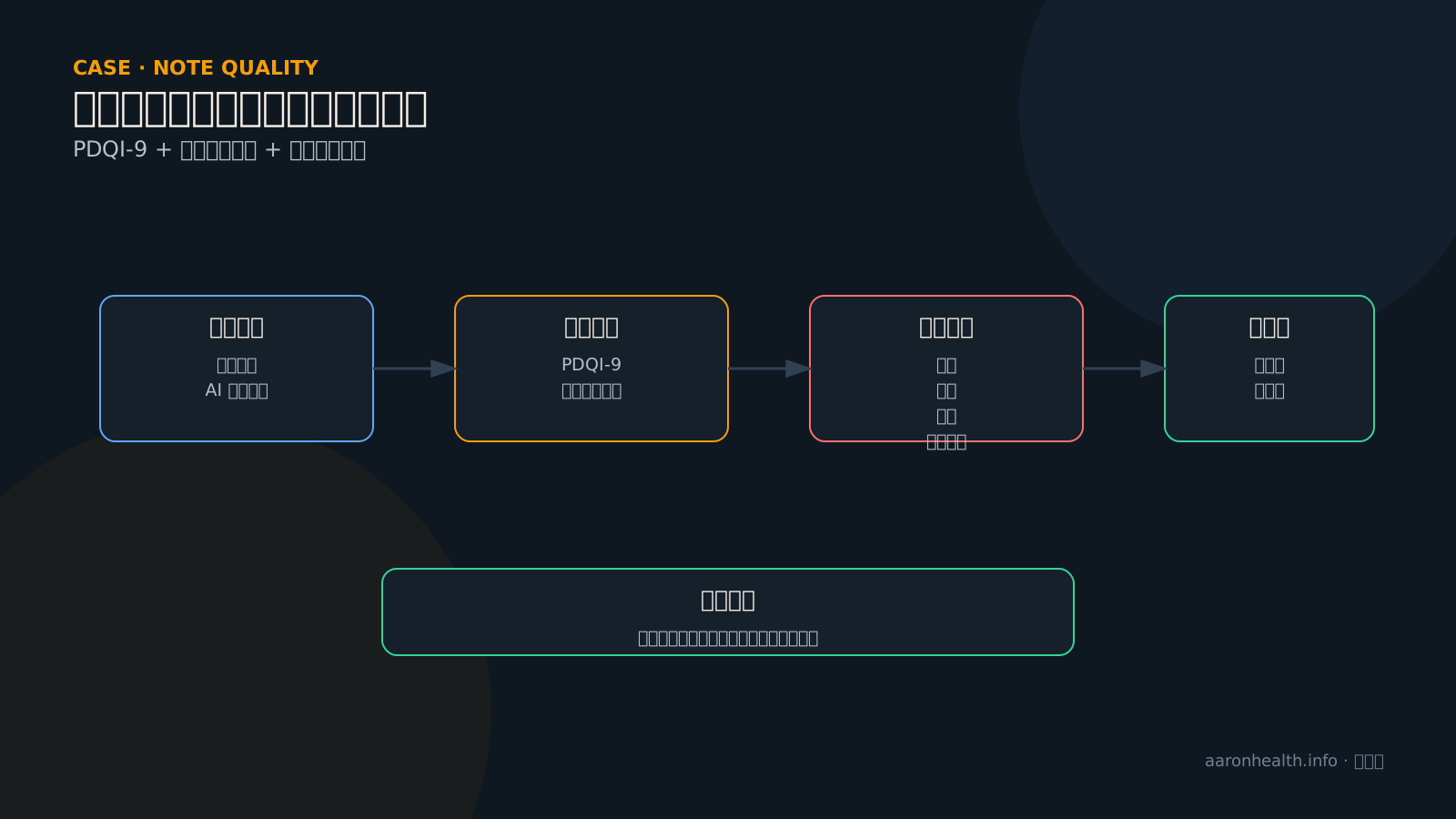
Clinical note quality control isn’t just “did they finish writing it.” It’s whether the note is useful, accurate, concise, well-organized, and easy for the next physician to pick up.
There’s a mature international approach for this called PDQI-9 (Physician Documentation Quality Instrument). It wasn’t invented for the AI era — it’s an earlier rating scale for the quality of EMR notes, asking whether a note is up-to-date, accurate, thorough, useful, organized, comprehensible, succinct, synthesized, and internally consistent. In other words, a clinical-note quality dataset need not be a simple “typos / missing fields” dataset. It can be:
- An original note, or an AI-generated note
- The physician’s final signed version
- Scores from multiple clinical experts, by PDQI-9 or your hospital’s own QC rubric
- Structured annotation of the discrepancies: omissions, hallucinations, redundancy, logical inconsistency, missing care plan
This kind of dataset is enormously valuable, because it answers one question directly: can the AI-generated note be safely picked up and signed by a physician?
But note the caveat: PDQI-9 is not a universal yardstick. Quality standards differ across specialties and across the ER / outpatient / inpatient settings. The sturdier move is: treat PDQI-9 as the starting point, then layer on your hospital’s own QC rules and specialty-expert scoring. See: Research on PDQI-9 for EMR quality assessment, and the recent line of work using PDQI-9 to evaluate AI-generated clinical notes.
The age of AI adds five more dimensions
The base 4 dimensions (completeness, consistency, integration, timeliness) stay — they’re the entry ticket. The AI era adds:
5️⃣ Standardization & computability (Standardization)
- Terminology coding (ICD/SNOMED/LOINC/RxNorm), unit standards, ontology mapping
- Skip this step and all the data in the world is just a data ruin
6️⃣ Representativeness & diversity (Representativeness & Diversity)
- Population coverage (age, sex, geography, comorbidity)
- Sample density for rare diseases and long-tail scenarios
- You can’t let the AI only handle textbook cases and collapse the moment it hits an edge
7️⃣ Annotation & expert-consensus quality (Annotation Quality)
- Who annotated it (a resident vs. an attending vs. a multi-expert consensus)
- Inter-annotator agreement (a Kappa coefficient > 0.8 is the floor)
- In medicine this one all but sets the ceiling — especially for imaging, pathology, and genomic interpretation
8️⃣ Knowledge density & reasoning learnability (Knowledge Density)
- Not just “a lot of data,” but “how much expert reasoning each record carries”
- One note with a full differential-diagnosis line of thought ≫ a hundred notes with conclusions only
- This is why reasoning models like o1 / Mythos depend on expert reasoning-trace data
- This is a dimension added in 2026 — 90% of the people talking about data governance never mention it
9️⃣ Compliance, safety & lineage (Compliance & Lineage)
- Privacy de-identification, informed consent, ethics approval
- Traceable data lineage — the make-or-break for medical AI reaching market
- Aligned with the Data Security Law, the Personal Information Protection Law, and the Measures for the Management of Generative AI Services
The 9 dimensions, each with a concrete medical example
The abstract 9 dimensions go in one ear and out the other. Pair each with a concrete scenario and they land:
| Dimension | Concrete medical example |
|---|---|
| Completeness | Chief complaint / HPI / discharge diagnosis are mandatory fields |
| Consistency | Patient sex matches across HIS / LIS / EMR |
| Integration | Lab orders ↔ physician orders ↔ notes are queryable end to end |
| Timeliness | Orders entered in real time; backfilling not allowed |
| Standardization | ICD-11, LOINC, SNOMED CT mapped hospital-wide |
| Representativeness | Rare-disease coverage; cross-province population distribution |
| Annotation quality | Three attendings blind-label imaging; Kappa > 0.8 |
| Knowledge density | Notes must include the differential-diagnosis line of thought |
| Compliance & lineage | Training data’s lineage traces back to the original note |
Extra dimensions for the legal industry
Beyond the universal 9 dimensions, the legal industry has a few of its own:
- Jurisdictional accuracy — mainland China / Hong Kong / the U.S. / the EU; one wrong word in a statute citation is an incident
- Currency — statutes get repealed and amended; citing an expired statute is a rookie error
- Adjudication tendency — the same case can lean differently across regions and courts
- Citability — you must be able to cite precisely to a specific statute and a specific judgment number
Together these four are the “legal industry + 4 dimensions,” stacked on top of the universal 9.
The core one-liners of this chapter
Traditional data quality solves “can it be used.” AI-era data quality solves “can the AI learn it right, judge it well, and dare to go to the bedside.”
The 4 dimensions are the entry ticket. The 9 dimensions are the AI-era maturity of a hospital’s data assets.
Next chapter: how high-quality data is formed — the traditional toolkit + the new AI-era meaning + three unsolved new problems.
留言
欢迎留言,匿名也可以。填邮箱能收到我的回复通知。