
How Data Evolves · From Analytical Data to AI Brain
Chapter 8 · The Data Flywheel and Three Future Trends
The previous chapters were about “how to do it now.” This one pulls the lens out two or three years and looks at how data will evolve.
The core shift fits in one line:
In the first two eras, data was used. In the third era, data is produced through use.
That is the data flywheel.
The three eras of how data is used
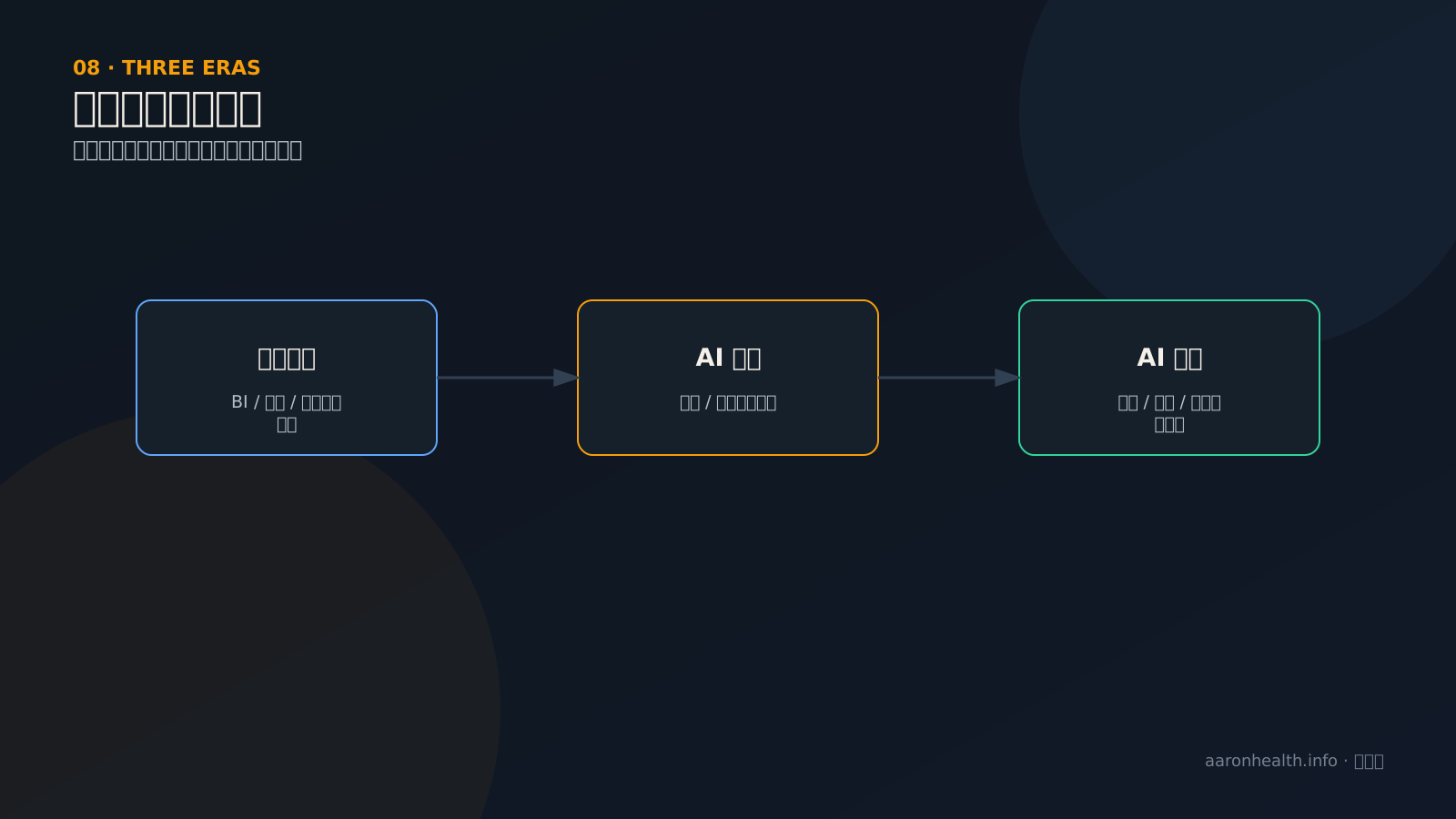
How data is used has moved through roughly three stages:
Stage one: analytical data.
Data is used to see the present clearly — to power reports, BI, operational analysis, and quality management.
Stage two: AI fuel.
Data is used to train models. Whoever has more data, cleaner data, more representative data, has the stronger model.
Stage three: AI brain.
Data is no longer just input — it is the organization’s knowledge, reasoning, feedback, and boundaries. It decides what the AI understands, how it judges, and whether it can close the loop in real business.
So the future of data building is no longer “tidy up the historical data.” It’s designing a mechanism that keeps producing new data as the business runs.
What the data flywheel is
The data flywheel is defined like this:
As AI is used, it continuously produces new data; that new data trains or optimizes the AI; the better the AI gets, the more people use it; the more people use it, the more high-quality feedback it produces — a self-accelerating positive feedback loop.
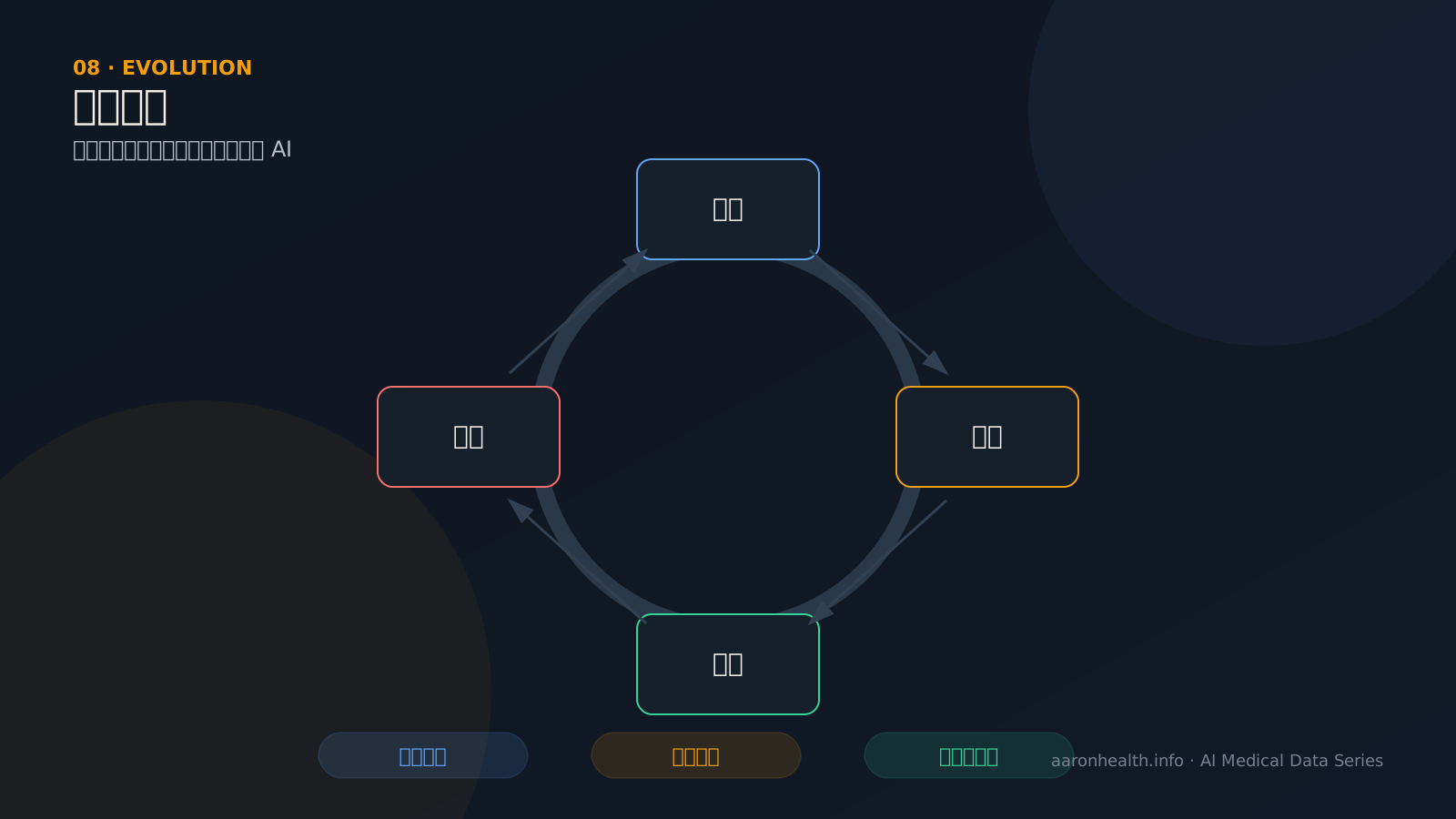
The flywheel has four gears:
- Use: doctors, patients, lawyers, and legal teams using AI in real scenarios
- Feedback: acceptance, rejection, revision, follow-up questions, human intervention
- Capture: structuring the interaction logs and feedback
- Evolve: retraining, updating the knowledge base, refining prompts, doing preference alignment
Then back to use.
Three flywheels in medicine
The imaging-AI flywheel: doctors confirm or correct the AI’s reads, the corrections flow back into the annotation library, the model iterates quarterly, and accuracy keeps climbing.
The clinical-agent flywheel: a CDSS makes a recommendation, the doctor accepts or overrides it, that becomes preference data, preference alignment follows, and the recommendations track real clinical practice ever more closely.
The patient-agent flywheel: user questions and feedback accumulate into a list of unresolved problems, the knowledge base fills the gaps, new tools plug in, and service capacity keeps expanding.
Law works the same way:
- Contract-review flywheel: lawyers revise the AI’s suggestions, preferences flow back, the model iterates
- Legal-research flywheel: lawyers accept or reject search results, the ranking model improves
- Trial-support flywheel: the disputed issues a judge accepts become reinforcement-training data
The three prerequisites for spinning the flywheel

Plenty of organizations say they want a flywheel, but it won’t spin — because three prerequisites are missing.
First, instrumentation engineering.
From day one, you have to instrument every interaction, every feedback point, every human-intervention point. Bolt it on after launch and you’ve usually already missed the most critical first batch of real usage data.
Second, experts in the loop.
Medicine and law can’t run on user thumbs-up and thumbs-down alone. At the key nodes, doctors, lawyers, or experts must review — otherwise the flywheel amplifies the noise too.
Third, evaluation as the gatekeeper.
Before every model or knowledge-base update, it must pass an independent evaluation set. You can’t train on feedback data and ship it straight to production — that contaminates evaluation and introduces bias.
Here’s a counterintuitive call:
A flywheel spinning too fast is also a risk. In medicine and law, a flywheel with no experts in the loop and no evaluation gatekeeper can spin the AI further and further off course.
This is especially true in law. AI hallucination is a disaster in legal scenarios — in 2024–2025, several U.S. cases of lawyers submitting AI-fabricated precedents drew court sanctions. The legal flywheel isn’t about spinning faster; it’s about spinning truer.
Three future trends
Trend one: synthetic data will matter more than real data.
Rare diseases, long-tail scenarios, privacy-sensitive scenarios — real data is never enough. Large-model generation plus expert verification is already a major method for training reasoning models. In medicine there will be synthetic rare-disease cases, synthetic pathology images, synthetic MDT reasoning chains; in law, synthetic hard cases, synthetic cross-border compliance cases, synthetic adversarial negotiation data.
Trend two: data goes from cost to asset, then to factor of production.
China’s “Twenty Data Measures” and the “Data Element × ” action plan have already placed data inside a framework for marketizing factors of production. A hospital’s specialty-disease high-quality datasets, a firm’s high-quality contract library, precedent-annotation library, and industry-compliance library — all become tomorrow’s invisible assets.
Trend three: evaluation sets will become the scarcest data of all.
Training data can be bought or synthesized, but the evaluation set decides whether the AI is fit for the clinic, the courtroom, the closed business loop. Every specialty, every critical legal scenario, should have its own gold-standard evaluation question bank.
This point is decisive:
You can buy the model. You cannot buy clinical truth or legal boundaries.
Wrapping up this chapter
In the past, data helped us see the present clearly; today, data trains intelligence; in the future, data defines the clinical and legal boundaries of AI.
An organization’s greatest asset isn’t how much data it has piled up — it’s how many data flywheels it has built that keep turning, with experts at the gate.
Next chapter: we anchor everything back to the business — don’t govern data first; work backward from core competitiveness to data building.
留言
欢迎留言,匿名也可以。填邮箱能收到我的回复通知。