
How to Produce High-Quality Datasets
Chapter Seven · Five Classes of Fuel, Five Production Methodologies
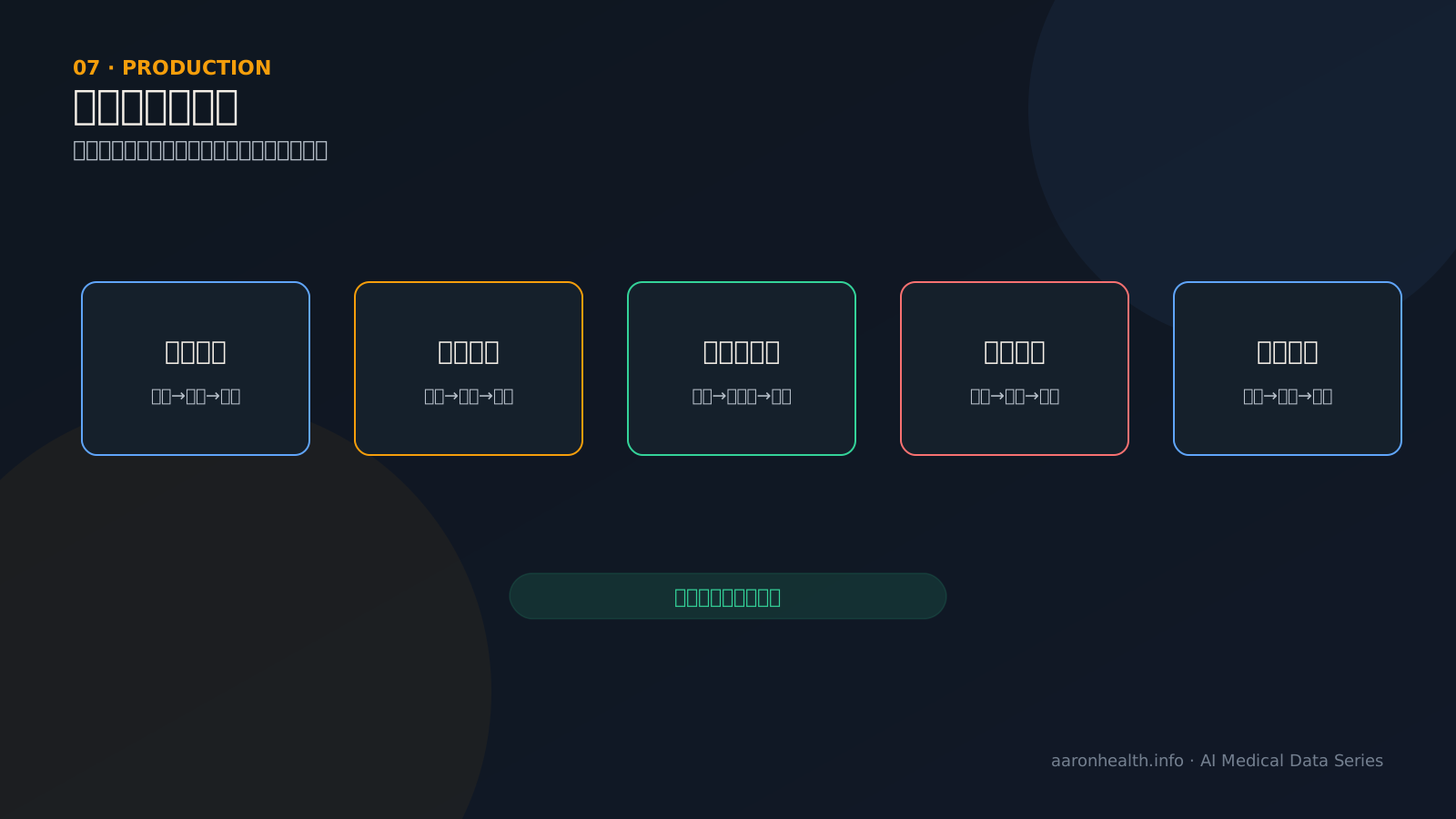
We’ve established that different AI scenarios feed on different data. This chapter answers the harder question:
How are these high-quality datasets actually produced?
The one-liner first:
High-quality datasets aren’t “governed” into existence — they’re “produced.”
Governance scrubs dirty data clean. Production crystallizes expert judgment.
So this chapter drops the generic data-governance talk and walks through a production line for each of the five classes of fuel.
Knowledge: the knowledge-engineering methodology
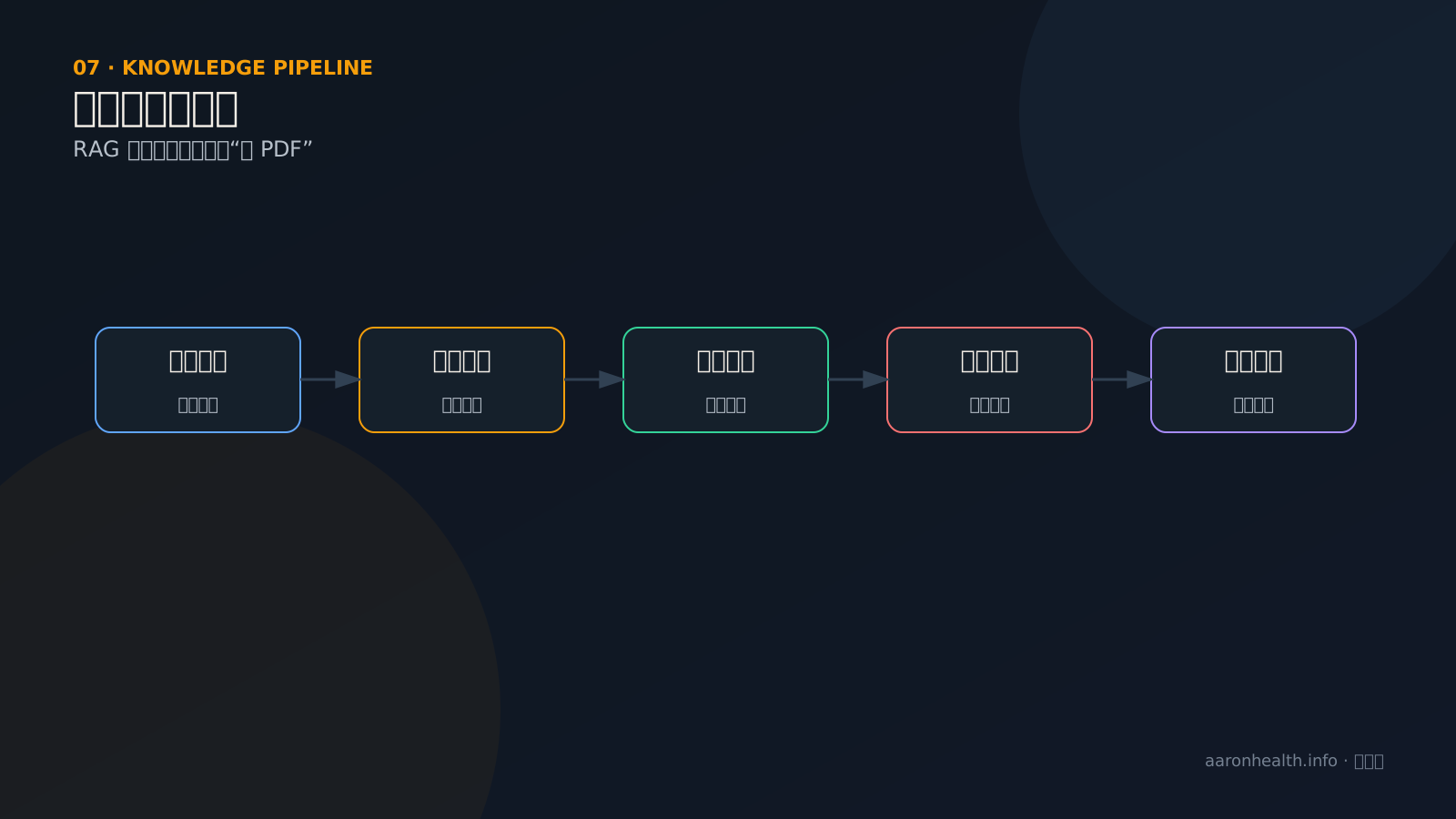
Knowledge applications are the most common — and the most misunderstood. They are not “dump the PDFs into a vector store.”
A serious knowledge-engineering line has at least five steps:
- Source authentication: regulations, guidelines, SOPs, and package inserts must come from authoritative sources and trace back to the original text.
- Parsing and chunking: split by semantics, not by character count; preserve the section hierarchy.
- Embedding and indexing: pick the right embedding model; for Chinese medical text, domain-specific performance matters.
- Retrieval with citation lineage: every RAG output must carry the source citation, version, and page number.
- Expiry and retirement: when a policy or guideline updates, the old version must be auto-detected, replaced, and logged.
The classic medical example is a health-insurance policy assistant: new policies are ingested each month, reviewed by experts, and regression-tested against 50 high-frequency questions before going live.
Law is actually a better fit for this path. Statute libraries, precedent libraries, and judicial interpretations are already highly structured — Beida Fabao, Deli, and Westlaw all run on knowledge-engineering logic. Law’s first wave of AI dividends won’t necessarily come from training models; it’ll come from getting the knowledge base right.
Data: the three-tier annotation pyramid
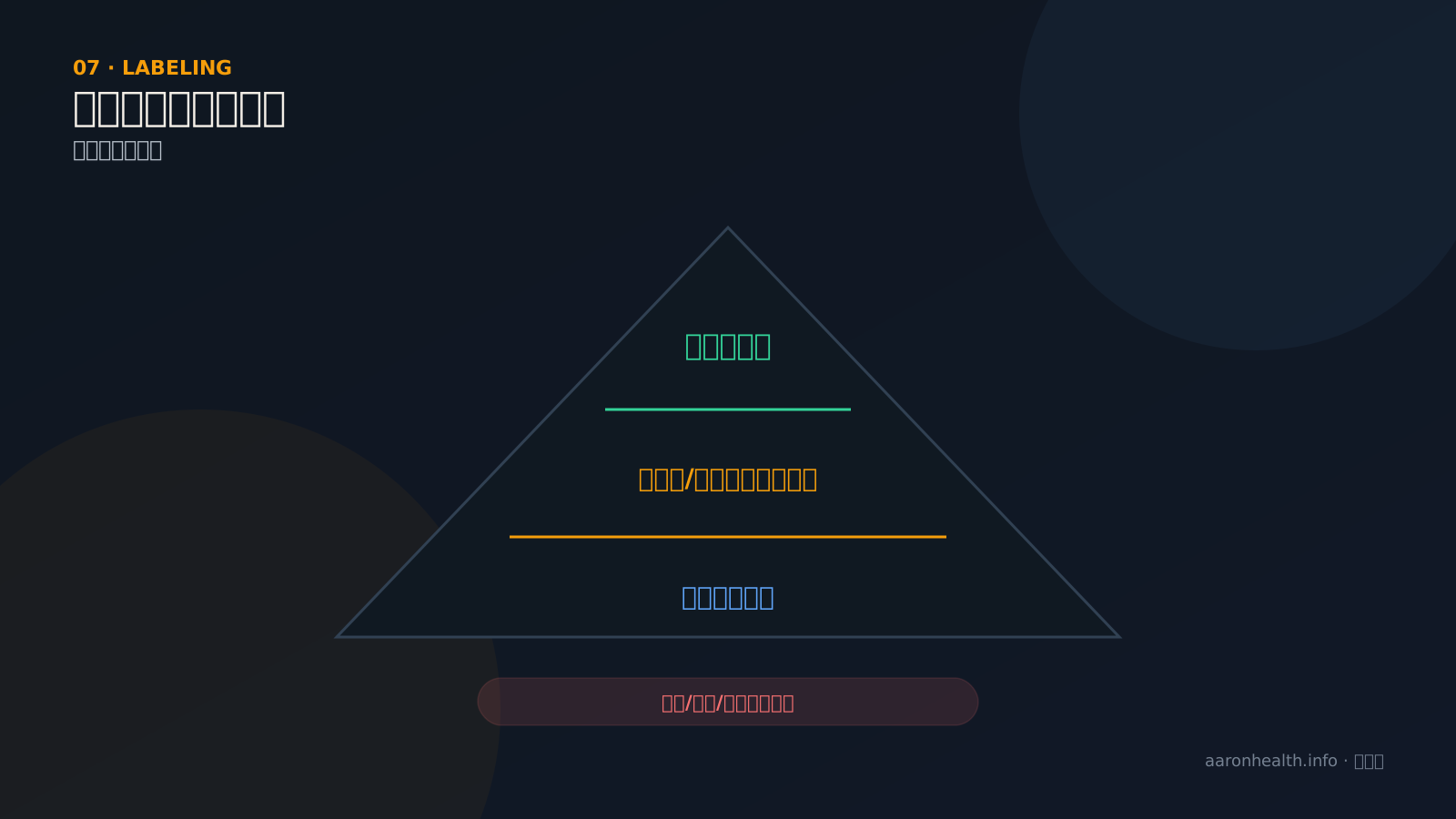
For data applications, the point isn’t “pooling data” — it’s building an annotation production line.
Think of it as a three-tier pyramid:
-
Bottom tier: automated model pre-screening
Weak supervision and model-in-the-loop filter out the obvious cases first, cutting the manual triage load. -
Middle tier: standardized annotation by residents/professionals
A unified annotation platform and SOP keep throughput and consistency high. -
Top tier: multi-expert consensus
Disputed cases get blind-labeled by three reviewers; the Kappa coefficient has to clear the bar before you have a truly credible gold standard.
And one iron rule: the evaluation set must stand independent guard — never, ever mixed with the training set.
What an imaging-sharing center is really fighting for isn’t “image aggregation” — it’s the cross-hospital annotation platform and the expert-consensus mechanism. Contract-review models work the same way: AI pre-screens risky clauses, legal staff annotate to standard, senior lawyers run the consensus review.
Reasoning: the reasoning-chain production line
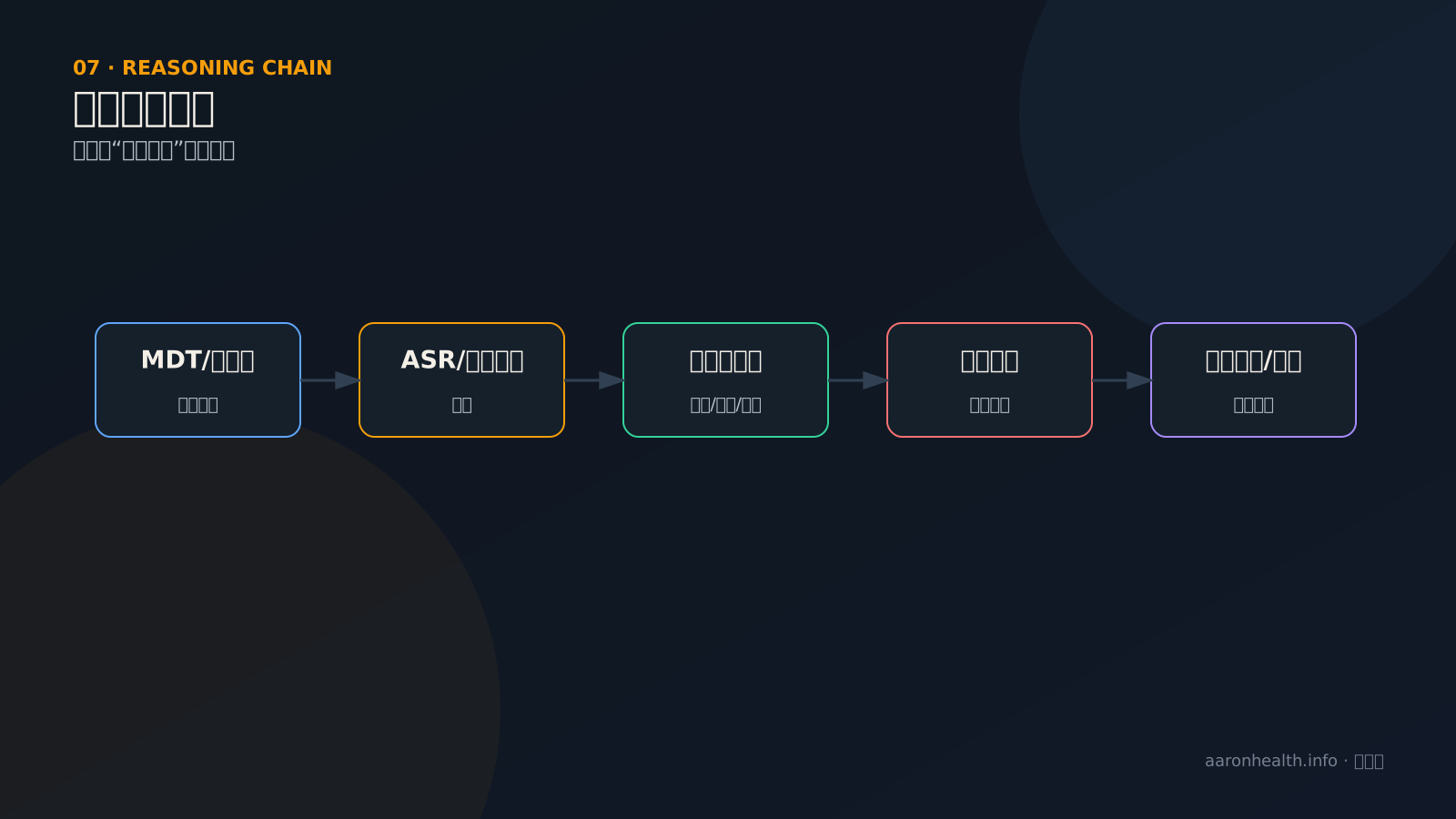
This section is the new engineering capability of 2026 — and the most valuable part.
Plenty of people talk about data governance. Almost no one talks about producing reasoning chains. But what a reasoning model truly feeds on isn’t just the conclusion — it’s how the expert thinks.
Reasoning chains come from three main sources:
First, MDT / complex-case discussions.
Run ASR transcription on the meeting audio, then structure it, then have experts review it. ASR is only the entry point; the structuring and expert review are where the quality lives. A year’s worth of accumulated MDT reasoning chains is a goldmine for clinical-reasoning agents.
Second, redesigning the medical-record template.
Add mandatory fields like “differential-diagnosis rationale” so the reasoning doctors normally complete only in their heads gets written down. The hard part isn’t the technology — it’s the institutional rules and performance incentives.
Third, AI drafts first, experts revise.
An AI draft lowers the expert’s cost, and the expert’s revisions naturally form preference pairs — usable for RLHF or preference alignment.
The key insight:
A reasoning chain is a new production line. You charter it, staff it, tool it. You don’t go mine an existing database and expect to find it sitting there.
Law has a natural edge here. The “reasoning for the judgment” in a court ruling is raw ore for structured legal reasoning chains. Whoever structures the reasoning, the points of dispute, the application of law, and the argumentation path best will hold the high ground in legal reasoning AI from 2026 to 2030.
International reference: three sources for clinical-note datasets
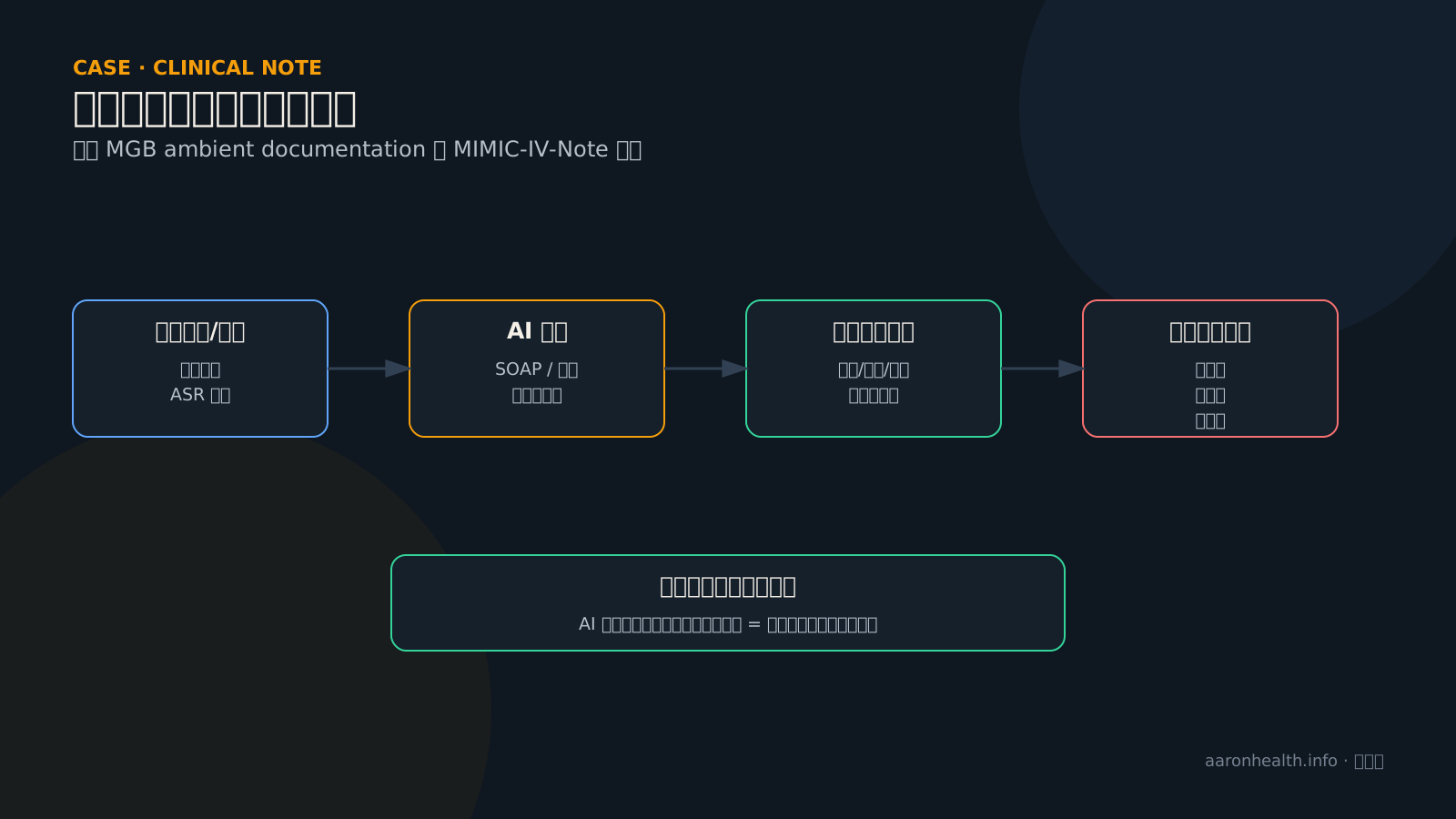
Clinical-note generation isn’t “have an LLM write SOAP notes out of thin air.” The genuinely valuable datasets usually come from three sources.
Source one: public de-identified clinical-note datasets.
MIT/PhysioNet’s MIMIC-IV-Note comes from Beth Israel Deaconess Medical Center in the US: 331,794 de-identified discharge summaries covering 145,915 patients. This kind of data is great for clinical-text understanding, summarization, structured extraction, and note-generation benchmarks — but its weakness is just as plain: it’s mostly historical documentation, with none of the doctor’s revision process from conversation to final sign-off. Reference: MIMIC-IV-Note.
Source two: real closed-loop data from ambient documentation.
Mass General Brigham’s public write-ups describe starting with a proof of concept of roughly 20 clinicians and about 500 encounters — watching whether the AI draft fabricated content, and what share of drafts made it into the final note; they later scaled to around 800 clinicians, and in recent years to routine use across 4,000+ providers. The lesson: what’s truly valuable isn’t the audio, and isn’t the AI draft — it’s the chain “audio/transcript → AI draft → doctor’s revisions → final sign-off.” Reference: Mass General Brigham ambient documentation and follow-up research.
Source three: divergence data from large-scale deployment.
Large ambient-scribe deployments like Kaiser Permanente / The Permanente Medical Group create core value not just by saving physician time, but by generating, every day, a huge volume of “differences between the AI draft and the physician’s final version.” Those differences convert into preference pairs, error taxonomies, quality-control rules, and specialty-template optimization data. For a hospital, that’s the flywheel feedstock for a clinical-note dataset.
So if we’re designing our own clinical-note dataset, the advice is to retain four layers from day one:
- The raw conversation or transcript
- The AI-generated draft
- The doctor’s revision trail
- The final signed note and its quality-control score
Only these four layers together make a clinical-note dataset that can keep improving.
Workflow/Agentic: flywheel engineering
For agentic applications, data production doesn’t happen before launch — it happens after.
The methodology is simple:
- Standardize tool APIs: lay down MCP / function calling / internal APIs.
- Instrument at launch: log success rate, human-intervention points, failure reasons, user edits.
- Weekly harvest: analyze the “Top 20 unresolved” each week.
- Optimize and iterate: add knowledge, tune prompts, add tools, fix the flow.
After a patient agent goes live, every unresolved question, every doctor rewrite, every patient follow-up is feedback data. A legal agent is no different: every time a lawyer adopts, rejects, or edits the AI’s suggestion is gold.
This will spawn a new piece of infrastructure: the Agent Eval Ops platform. It’s not a traditional monitoring system — it’s the evaluation, feedback, regression, and launch-gating system for agent performance.
Embodied: multimodal manipulation data
Embodied data is the most expensive — and the hardest for any single institution to pull off alone.
It has three main sources:
- Real-robot capture: surgical robots record vision, force sensing, and motion trajectories — costly but real.
- Expert demonstration: doctors wear motion-capture rigs to produce VLA data.
- Simulation: a digital-twin operating room generates synthetic data to fill the long tail.
The core of this data isn’t the single case — it’s the synchronized multimodal stream: visual state, natural-language instruction, motion trajectory, force feedback, failure-recovery path.
The key call:
No single hospital can fund embodied-intelligence data alone. You have to co-build it with the robotics vendor.
Embodied intelligence is rarer in law, but courtroom-audio transcription, AI trial assistance, and AI legal kiosks already show early signs of it.
Four shared steps
Whatever class of data production line you’re running, four things are unavoidable:
- Source authentication: where the data comes from, whether it’s authoritative, whether it’s usable.
- Governance process: who reviews, how they review, how versions are managed.
- Tiered evaluation: strict isolation of training, validation, and test.
- Feedback loop: how it flows back after launch, how the flywheel keeps turning.
This chapter ends on a single line:
Producing high-quality datasets takes more engineering muscle than governing them.
Next chapter, we pull the lens back: how will data itself evolve?
留言
欢迎留言,匿名也可以。填邮箱能收到我的回复通知。